Legacy of Kain - The Rest of the Series
I return to my project of replaying through the Legacy of Kain series - and after playing Blood Omen for the first time, I've now reached the point where we're in familiar territory. The rest of the series I've played and replayed through several times, some games more than others, and so this hasn't exactly been a case of seeing whether my memories of them hold up. Rather, I started doing this simply because I wanted to re-experience them again, because I barely have time to replay games these days even though I really want to and so I purposefully put time aside to revisit these games that in one manner mean quite a bit to me. In the process I've of course had the chance to re-evaluate and examine them in a little more detail as I go through them back to back, and I was originally thinking of doing a separate entry for the rest of the games. But the more I think about it, the more it makes sense to tackle these games together. Not just because they're literal direct sequels and quite literally start where the previous ones finish like seasons on a TV show, but a lot of my original love for the series stems from these games in particular. Soul Reaver 1 & 2 recently had a bundled-together remaster release as well (which I'll write about at the end), so it makes sense to talk about them together, and adding Defiance to it ultimately just ended up happening naturally.
So, this will be a slightly longer entry, apologies.
Legacy of Kain: Soul Reaver (1999)
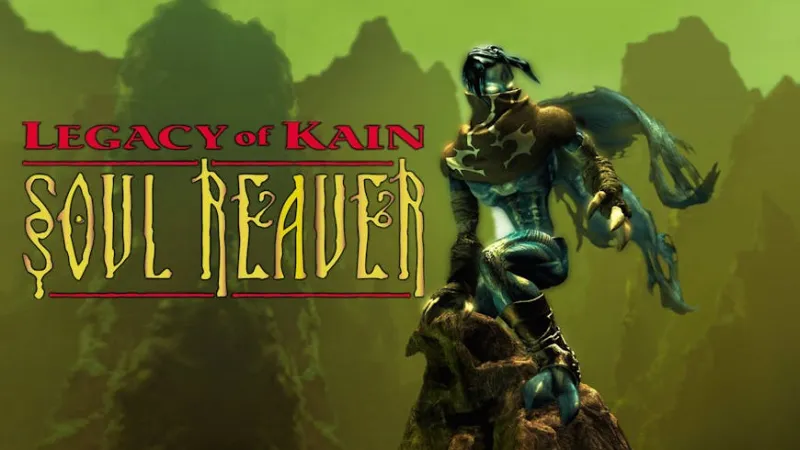
The more I think about how I got into Soul Reaver, the weirder it is. I, a PC-only gamer at the time, was reading a Playstation magazine (in my defense it was the free first issue of the PS offshoot of the PC gaming magazine I read religiously) and stumbled into the demo review pages. The preview of Soul Reaver's demo had half a page to itself and... something made it jump out to me. I never got the chance to play the demo myself, but the couple of screenshots included and the description of the game made it sound so interesting that I found myself pre-ordering the PC version of the game, back when pre-ordering meant going to the physical store and asking them to order and reserve a copy for you.
I think that there would be a really good chance that, if history had played out a little differently, the first Soul Reaver would have come to define a significant part of my personality. I stepped into the game completely blind with absolutely no idea what to expect beyond the few words in the review for the PS demo, and it became a title I'd replay over and over again, priding myself in finding and knowing where every little collectible and neat little thing was. I could quote the dialogue off memory despite the lack of subtitles and the prevalence of fancy words that I barely knew the meaning of, and I could replicate all the clan symbols that I had memorised upon my hours of time sunk into the title. Soul Reaver sucked my soul in and didn't let it go.
(... and this really is a sneaky entry to my glacial Cornerstone Games series about the games that have had massive impact in my life. Surprise!)
It's the world building that makes it. That phrase gets thrown around a lot these days and has sometimes become associated with lazy attempts at franchising/dumping infinite amounts of uninteresting l o r e in an attempt to look deeper, but in the case of Soul Reaver, they really build a goddamn world. The background comes from Blood Omen of course because we're still in Nosgoth, but Soul Reaver takes place roughly a millennia after the events of Blood Omen and that time span gives a heck of a lot of space to create something truly memorable. The protagonist, Raziel, was one of former Blood Omen protagonist Kain's vampire lieutenants following his rise as Nosgoth's ersatz tyrant; unfortunately Raziel had the indecency to continue on his vampiric evolution before Kain did and as thanks of his lieutenant growing wings, Kain rips them off and casts Raziel to the bottom of the lake where he lies dead until a mysterious force brings him back to (un)life. When Raziel returns to surface, he acts as the player's handy POV character to understand and explain all the changes that took place while he was out of the game. Nosgoth's vampiric terraforming has seeped into every ruin and crevice, the handful of remaining humans have come up with ways to try to remain secure and Raziel's vampiric brothers (and their armies) have all had their own evolutionary paths, leading them to varying stages of inhuman monstrosity (side note: Legacy of Kain has the only good and interesting vampires in the history of vampires; no offense to any vampires I might know). Bit by bit the world continues to expand in both scope and in depth, environmental tidbits and Raziel's internal narration divulging in the details. It is so masterfully done and every new location, be it a flashback to Blood Omen or a brand new area, is realised wonderfully. The world of Soul Reaver truly pulls you in.
As do the writing and the characters. Raziel's journey through Soul Reaver is largely a lonely affair, usually only left to his own thoughts or exchanging a few words with his dear brothers before the battle to the death begins. His main conversation companions throughout are the Elder God and Kain, his supposed helper and enemy respectively. Each and every conversation with them is a highlight. Blood Omen already featured way better acting than a game of its ilk had any right to, and Soul Reaver only ups the ante as these theatre professional trade dramatic, verbose sentences with each other. Michael Bell as Raziel, Simon Templeman as Kain and Tony Jay as the Elder God are all phenomenally cast and every single cutscene is a real joy. As Raziel's adventure starts to hint at being so much more than just a simple series of revenges against the family that killed him, each actor captures those hidden motivations and changing attitudes phenomenally. The Legacy of Kain series as a whole features some of the greatest acting I've ever heard in a video game, and the writing in Soul Reaver in particular is a true joy to experience. One of the best benefits of the 2024 remaster is the inclusion of subtitles, so you can really get to grips with how stylistic the language in this game is.
The game underneath was - is - excellent as well. Despite doing its darnest to obfuscate it, Soul Reaver falls into the classic Zelda formula: traverse the overworld, seek out independent "dungeons" within, beat bosses and obtain new skills and items, use said unlocks to find new ways to explore the overworld, etc. I've always had a lot of love for the classic 3D Zelda formula1 and especially in today's climate where Zelda is more or less dead (kept alive by the empty meandering simulator that has the game title slapped on the box), it feels all the more special. It's the perfect blend of linearity and openness. The world feels meaningfully designed rather than endless open plains meant for nothing but wandering around yet broad enough that traversing it behaves like a vast adventure into the unknown; whilst broad and interconnected, it's built in such a manner that when you do have to retrace your steps (or do a little extra treasure hunting), you have a tight idea of where you should be going because you'll have picked up on it consciously or subconsciously along the way.
Like Blood Omen (attempted), Soul Reaver prides itself in limiting the player in a various ways and then encourages them to tactically plan or even play around those limitations: enemy vampires will quickly jump back up unless executed so the player learns to keep an eye on the environment to offer those options, your spirit blade can only be active at full health so care and planning are rewarded, and shifting between the material and spirit world (which Raziel can do at will as a wraith) can sometimes be used for tactical maneuvering and strategy. Shifting between the two is also one of the game's main selling points and most important puzzle mechanics (alongside boxes. So many boxes) and whilst swapping between two slightly different dimensions of the same place to open new paths etc is a common trope now, Soul Reaver is one of the reasons why it's a common trope. It's still among the best of its kind too, not just in how the puzzles are executed (given physics do not exist in the spirit world which really makes you think the relationship between the two dimensions) but the atmosphere of it all. Raziel shifting into the spirit world at first feels haunting in how warped, hazy and lonely (save the few wandering spirits of vampires slain and other scavengers) the ghostly surroundings are, but by the end of the game as both you and Raziel are more accustomed to it, you start feeling strangely powerful as you toggle between the two.
("Ozar Midrashim", composed by Kurt Harland and licensed for the game to be used in its opening cinematic, is in my books one of the greatest game themes out there. Crystal Dynamics in fact thought of it so well that they asked Harland to compose the entire soundtrack in a similar vein, leading to a really fantastic and eery score.)
I've replayed Soul Reaver so many times over my life but it's been a while since the last time. Coming back to it again has done little to tarnish its strengths and personality. It still feels so incredibly well designed right down to the smallest detail that it's addictive and hypnotic to play - I finished it in a matter of a little over a weekend because I couldn't stop myself. If you're sharp-eyed you can detect that the game was a victim of heaps of cut content: the single elemental blade upgrade feels both incredibly random and wholly under-utilised, the human citadel is little more than a series of power-up locations and one of Raziel's brothers is curiously missing and never alluded to within the game. And yet, you never miss any of the lost chances. Soul Reaver presents such a gorgeously realised vision that it earns its laurels as one of the best action/adventure titles of all time, which even today has a wholly unique aura around it. Between the world, the writing and the gameplay there's nothing quite like Soul Reaver and if anything, it has aged like fine wine.
Legacy of Kain: Soul Reaver 2 (2001)
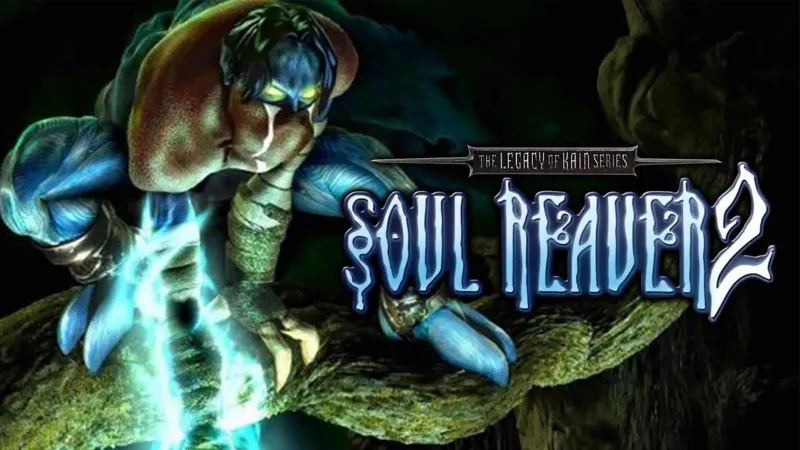
Soul Reaver 2 is a curious sequel. The original game was very acclaimed, both as a game but also on account of its writing and acting - the high quality of which stood out even more in the late nineties. The team - and lead writer Amy Hennig - took this as an encouragement to push the latter even further in the sequel. There would be now be a lot more dialogue between different characters (Raziel did, after all, spend much of the first game monologuing), many more cutscenes with more dynamic action, and a deeper focus on the grand machinations behind the plot. Indeed, Soul Reaver 2 is the game that sets in stone the core themes, plot elements and key players of what we now associate with the series - out of all the games, it's the most crucial keystone of them all to understand exactly how things escalated from where we were to where we would go.
The gaming part, however, seems to have been an afterthought.
Well, that's hyperbole. For most parts (put a pin on that 'most') Soul Reaver 2 is a good game, and dare I say that in terms of most puzzles it very clearly beats the first game's infinite amounts of block puzzles - some of the key puzzle areas (i.e. the Reaver forges where you get your new upgrades) can actually make you stop and think for a second. It is, however, a game completely in service of its plot structure. And what an ambitious narrative it is! Continuing directly from where Soul Reaver 1 finished (extracurricular reading tells me the games were meant to be one and the same but budget constraints forced Crystal Dynamics to abandon the idea and reformat Soul Reaver 1 to what it would eventually be), Raziel's continued adventures take him through multiple different eras as the game wholly and unashamedly jumps into a tangled and complicated time travel plot (the likes of which Blood Omen's dabbles at it already hinted), complete with detailed contemplations on fate, free will and time paradoxes while accounting for all of them instead of dodging the headaches. As Raziel uncovers the hidden story of Nosgoth and himself, he bounces between multiple parties where you can never be sure who's playing who's game, until it all concludes in a series of headwhack realizations and plot twists, while seemingly everything vaguely mentioned in the first two games ends up having stronger ramifications than initially thought. My first ever playthrough of Soul Reaver 2 in 2001 was thoroughly confusing because so much of it went through my head, thanks to a combination of its oft-convoluted whiplashes and the brilliant purple prose it was written with that I had to dig out my dictionary for; my younger self would have really appreciated the subtitles that the remastered version finally comes with.
Like all the characters who are locked on the rail that destiny has built for them (save our precious blue boy, the one true agent of free will), so too must the game serve the story being told. Gone is the open world of the first Soul Reaver, replaced by a facsimile that looks broad and wide at first glance but turns out to be a long-winded tunnel where you only ever travel in one direction, with nothing to explore for in-between. Said tunnel also becomes increasingly overfamiliar as the game progresses because the time travel plot offers an easy excuse to re-use the same map over and over again with small tweaks to the enemy skins and light levels, until it becomes monotonous. There are no collectibles, no optional side paths, no places to use any of your new upgrades except for the plot gates placed on the opposite ends of the map. Raziel retains his skills from the first game (except for the admittedly forced constriction ability) and learns nothing new, with all his new advancements this time being different elemental augmentations for his spirit blade, which offer very minor puzzle elements and mostly just act as different colour options for the blade. Soul Reaver 2 is incredibly streamlined compared to the first game and if you're not in it for the plot, it's unlikely the gameplay is enough to capture you.
Especially when the combat rears its head. Soul Reaver 1 was no fighting game but it treated its fights like puzzles: it wasn't enough to knock your vampiric foes out, you had to dispose of them, and each fight was at best a choreographed dance of opportunistic strikes. In Soul Reaver 2 you primarily fight humans and demons (returning from Blood Omen), and whilst both the finishing moves and different weapons return they are here for show purposes only as neither are really needed. The Soul Reaver can now be summoned at any time and not just at full health and though the game balances this by the sword consuming your expected health drops and attacking you if it gets overcharged, the trade-off isn't interesting. Worst though, the fighting is simply incredibly boring and there is so much of it, and often mandatory in order to open doors or cause the magically appearing forcefields to vanish. Halfway through the game you begin to encounter enemies who can block your attacks and so each fight becomes an extensively boring attempt at trying to side step and land hits against enemies who can turn to face you in a snap. Sooner or later you want to start avoiding every non-mandatory fight and so the traversal in the world becomes a series of hasty run-ins and escapes - press forward to keep advancing without looking back at anyone who follows and tries to stab you. The fighting on Soul Reaver 2 is a chore and as its final acts descends into an endless series of battles as you run through the Tunnel for the last time, climaxing in a sequence of final matches that are so important to the plot that you're literally given invulnerability during them which makes it even more boring, you really begin to miss the vampire fights and puzzle bosses of the first game. Oh, and by the way, there are no bosses whatsoever this time around either.
You would think based on the above I hate Soul Reaver 2 but, well, it's a fine game for all its flaws. Turns out, I really am a sucker for that plot: as mentioned this is where the saga really begins to kick in one new gear after another and it's a genuine thrill to uncover the hidden layers and watch as multiple characters' multiple gambits all clash together. The acting is superb and whilst Raziel is already a dear and beloved character for everyone who played the first Soul Reaver, SR2 effectively re-establishes Kain as a character, transforming him from a one-note anti-hero/absent antagonist into a friend-or-foe companion full of complexities of his own, brought majestically to life by Simon Templeman's bravado. I generally speaking do not care for time travel plots but SR2's constant twisting of new knives into the proceedings is enticing throughout. And whenever you're not battling anyone nor idly realising how limited and the empty the world feels compared to the last game - whenever the game stops for a moment and presents you with a multi-level puzzle disguised as a temple that you crack open step by step - it can even engross you. Soul Reaver 2 has many flaws but endures despite them. But it is also the middle part of a trilogy, and comes with all the trappings of that.
Legacy of Kain: Blood Omen 2 (2002)
So, I copped out on this one. My original plan was to replay through all of the LoK series but at the end of the day... life's too short to replay run-of-the-mill generic action games. Blood Omen 2 was not developed by Crystal Dynamics and only relates in the most tangential way to the rest of the series: it's a self-contained story that takes place in an alternative timeline and its most story-relevant beat is how it reveals a little more about the Hylden, who were briefly namechecked in SR2 and who become the main antagonist faction in Defiance. Replaying Defiance, it actually struck me how little they ultimately elaborate on the Hylden beyond the basic of where they've been and what they're planning to do, so in that sense BO2 is maybe worth checking - to add a little more meat around the bones of the guys you beat up in the next game? But as a game it's about as generic a PS2-era 3rd person action game as you could get, with a one-note script and thoroughly rote gameplay. The puzzle bosses are back which is the best thing about the game, but otherwise, it's such a 6/10 experience that I thought I just don't need to experience it again. Replayed it enough times when I was young and had limited money for new games to know where I stand. And I had actual plot to follow.
Thus, onto Defiance it is.
Legacy of Kain: Defiance (2003)
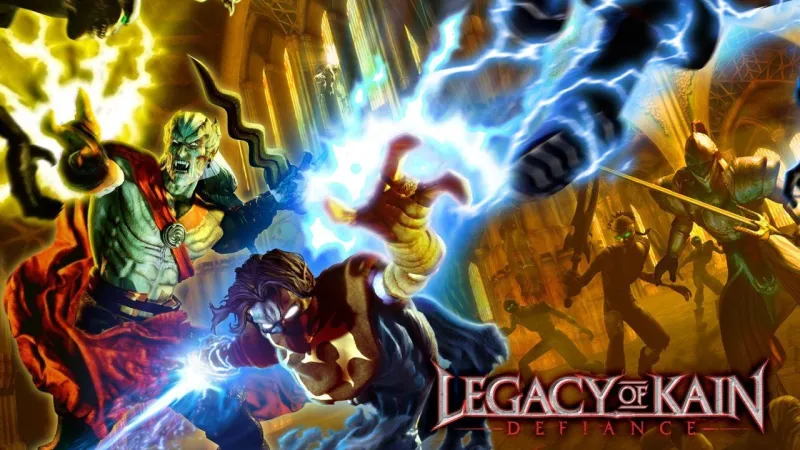
One of the major plot points of Defiance is to do with two prophesised champions that are depicted in murals throughout the ancient ruins where the bulk of the game is set. These images ostensibly depict the chosen heroes for both warring factions, the vampires and the Hylden, in conflict and destined to battle each other to determine the ultimate fate of things to come: the mystery is that over the course of the game you discover different future-describing paintings where either side delivers the final blow, and the questions come in form of what is the actual truth here and who the champions are meant to be. This, conveniently and 100% coincidentally, also serves to describe Defiance really well. It's a game where opposing forces tug and pull at each other in its design, and throughout replaying it I kept going back and forth whether I actually appreciated those facets or not. It is both a refinement and sharpening of the elements that Soul Reaver 2 brought into the series, and at the same time it further digs into the flaws those elements bring. It somehow leaves me both satisfied and conflicted.
At its base gameplay, Defiance continues SR2's linear and action-heavy approach - this time, however, they've actually designed it as an action game from the ground up. There are actual combat mechanics! Dodging, combos, fluid locking, special moves, the ability to quickly change Reaver elements on the fly with each of them coming with unique combat side effects - you play as both Raziel and Kain this time around and the two even have slightly different combat styles. During its plentiful combat sequences Defiance plays a little like a less elaborate Devil May Cry, and it's a vast improvement over Soul Reaver 2 awkwardly trying to fit SR1's combat mechanics into more involved battles. You do plenty of battling in Defiance, often against multiple waves of enemies, but it only occasionally gets tiring (and primarily against the living statue enemies which are mainly just dull damage sponges) as all the changes made to the combat mechanics keep it enjoyable; not particularly complex and maybe a little unfinished, but never tedious either. The main negative about the combat is the awful camera which this time around opts for "cinematic" fixed camera angles instead of free-moving camera behind the character's back, and most of the time it only makes platforming more difficult and hides characters behind pillars and walls during battles.
The flipside is that this further focus on combat and the enhancements made to its flow have all but ensured that the level design has to complement it. At least they are honest about it: there's none of the fake overworld freedom that SR2, and Crystal Dynamics have simply embraced railroaded tunnels with no shame. I don't think that's automatically a negative, but funny enough it's the other design decisions around it that end up casting it in bad light. For one, Kain and Raziel start their respective stories in different time periods after SR2's timey-wimey shenanigans and that gives the devs the perfect excuse once more to re-use the same environments over and over again: sometimes you advance them in reverse order or there are some minor cosmetic changes, but they're still the same tunnels. I presume everyone who plays this game will ultimately get sick of the ancient vampire fortress where a good 2/3rds of the game is spent in, Raziel zipping in and out of different sections of them while Kain zooms through them in cross-cut of the different levels. There is literally a single instance of Kain's actions in the past affecting Raziel's level layout in the future in a manner that feels almost like an afterthought, and it only makes me want more of that potential to be tapped into - as it is, the 500 years between them barely affect the repeat environments. The game has also all but done away with the puzzles and the few they've kept as lip service to the Soul Reaver games feel condescending at best: simple key hunts that make you backtrack for nothing, or the bare minimum use of different Reaver powers at select hotspots. Raziel still has his ability to shift between dimensions but it's used for the bare minimum action of moving platforms around; Raziel can now even climb walls in the spirit realm which was a big no-no in the past, simply to remove even that consideration from the proceedings. The whole mechanic ends up having a far more important purpose in the plot than it does in the gameplay, which is wild.
As for the story that all this linearity serves, Defiance is a little lopsided in this aspect as well. The key plot beats are excellent: Defiance was not meant to be the end for the entire series, but it was planned as a conclusion for Raziel's main story arc and it does that job incredibly. There's a few great twists, the key loose ends all the way from Soul Reaver 1 are wrapped up satisfyingly and everything builds to a largely satisfying grand finale with excellent stakes at play. All this, however, occurs at very specific places in the plot. Both protagonists spend most of the game collecting their individual Reaver power-ups for... the purpose of having Reaver power-ups mainly, and to get through arbitrary locks requiring said powers. Most of the narrative is quite literally narrated as the characters come across the aforementioned wall murals and dump exposition disguised as their internal musings. It's only in the last quarter of the game where all the key players actually start interacting and talking to each other, and every single one of those moments is brilliant. They're just so few and far apart that it gives the rest of the game a weird sense of being made out of filler levels. A good chunk of Defiance feels like a waste of incredible actors, good at monologuing as they are.
But... it's good, warts and all. I have no idea how Defiance would come across for someone who hasn't played the previous parts (the sheer idea of someone jumping blind into this narrative right here is so daunting), but for me it manages to overcome many of its flaws through the sheer power of the franchise alone. Now to be fair, the game does downright pander for this exact audience - much of the music of Raziel's sections is lifted directly from Soul Reaver 1, some of its key locales include dungeons from the first Blood Omen now finally in 3D, and the game generally loves to nod in the direction of the two games that started this all. It's almost like a homecoming of sorts, especially for fans of Soul Reaver given all the closures to its hanging threads. The gameplay might be basic all things considered but Defiance is at least confident about what it aims for, and that makes it an enjoyable action game to button mash your way through. It's a mixed bag but with so much good, interesting and fascinating in that bag that it leans on the positive. Like the bulk of this maddeningly uneven series.
And what a strange series it is
If you asked me if I'm a fan of the Legacy of Kain series I would on a heartbeat say "yes", but that isn't a question that has a simple answer for anyone. Truth be told, it is a mess of a franchise. Almost every single game comes with a mountain of cut corners, deleted content, aborted ideas and streamlined ambitions - if they had actually been released in the form that any of the original design documents suggested, this would be a wildly different set of games. The entire series is cut content, in fact: Defiance was never meant to be the definitive end and its final moments set up the scene for the next game to come, which was cancelled soon into the start of the development (there was an in-name-only multiplayer shooter years later which has been buried deservedly and no one counts as part of the lineage). Out of the five games that compasses it, only one is legitimately great and the rest fall somewhere in the 'your mileage may vary' axis, all praises coming with asterisks and caveats. It is honestly a frustrating series at times, as is evident from all the rambling above which has a distinctly negative tint for a set of games I ostensibly enjoy.
But you can't help but love the ambition and when it comes through, it's so good. All the way from the first Blood Omen you can detect the pure passion and love that's gone into the story, the world and the characters and though those rarely translate into ideal gameplay experiences, they are the blood and soul of the series. Soul Reaver 1 of course is the one unadulterated masterpiece, a near perfect combination of gameplay and vision, but all the others (apart from Blood Omen 2) share much of what made that game such an experience: they just do it in a completely crapshoot manner where it feels like you're always balancing the good with the middling, and you have zero idea whether it's another fantastic moment or an annoying disappointment waiting around each corner. You can perhaps distill it best by saying that the Legacy of Kain games stick with you: that they have never suffered from being forgettable, that there's so much magic and personality to them that they find a permanent home in your head for years. Coming back to these games with modern eyes and mind has only reinforced that idea. It's a one of a kind game series that absolutely deserves to be played and discussed to this very day - but it is by no means a back-to-back run of iconic, golden games at the same time.
The SR1 & 2 Remaster
So, finally, a small word about the recent remaster for the two Soul Reaver games. They are, for all intents and purposes, the best way to experience these two games now. They are remasters, not remakes: everything about the original games has been preserved as-is, but there's a new coat of paint on them and they've a few little bits of QoL to enhance the experience e.g. subtitles. There is honestly very little to say about the remaster job beyond this because of how faithfully it's been done, and that's a stark positive in this case - if it makes easier to revisit these games, the better.
But then there's the bonus content for us fans and it's a remarkable treasure trove. Everything that was already included unlockables in the original games is here: sketches and artwork primarily, but also the wonderful behind the scenes vignettes of Soul Reaver 2's actor recording sessions where you can watch this great talent share the same studio for the authentic dialogue experience and have a great time together. A whole bunch of additional visual material has also been shared, from all the promotional artwork to a full map of Nosgoth where you can flick through the different time periods, and there's even a section for fan art and cosplay.
But the big surprise here is all the Soul Reaver cut content. Out of all the games in the series, the first SR1 went through the most changes during development: the game had a vastly different plot and pace at one point, with several locations planned and ultimately deleted. However, they made some ways into developing these areas and the fantastic fansite The Lost Worlds has served for decades as the information hub about all this for all the fans. The remaster allows people to actually play these lost levels - yes they are all very WIP with broken scripting and puzzles, but there's enough there for them to act as interactive museum pieces, and it's just wonderful. You can actually almost completely do the lost fight against Turel in Soul Reaver 1, complete with some of the voice acted dialogue still in place. The great thing about this is that it's all thanks to Lost Worlds, and the site's host Ben Collins has been invited to write all the preambles for these areas. It's really incredible and a truly great piece of video game preservation.
A similar remaster was announced for Defiance while I was in the middle of playing the original game, and which I only learned about in the days immediately after its completion - I could have just waited... One of the extras is a playable demo of the game that was meant to follow after Defiance, which is an even more insane thing to dig out. I'm... kinda interested about that, not going to lie.
At this point some will point out metroidvanias exists, given they share many of the same traits. But I've yet to discover a metroidvania that isn't a 2D sidescroller designed for genre masochists, and they by and far feel a lot more mechanical than the classic Zelda formula. The 3D Zelda-likes have the tone of a grand adventure that slowly unfolds into widescreen as the player explores the world and builds their skills until they master their repertoire; metroidvanias meanwhile have the overwhelming feel of a puzzle box of mechanics and tricks that the player needs to solve in order to beat the game at its own, well, game. At least, that's how it feels to me.↩