Games wot I've played over the past few months
I've been playing games recently too! I've just not been posting about them, though I've kept my habit of trying to say a little something about each one in my BackLoggd account. But for those who don't follow me there, here's a big ol' review dump of games I've played and completed over the past couple of months.
Grotto
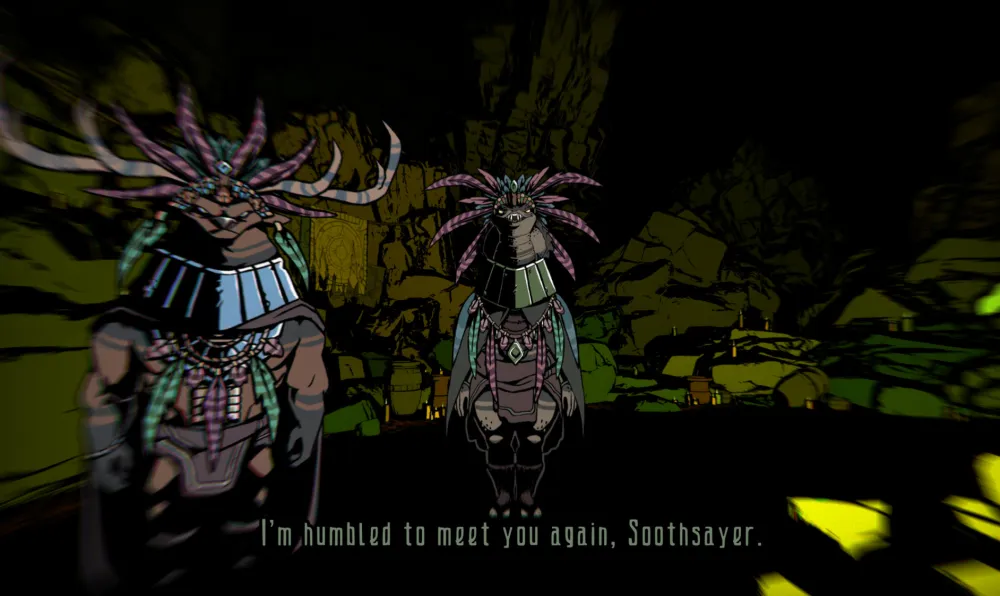
You are a soothsayer in a cave (a grotto, if you will). Denizens of the local village come to you for guidance and you consult the stars to provide it. Only, the stars are ambiguous; each of the constellations you use as your tools not only represents something visually (animals, objects, concepts), but they come with a cryptic representation of their meaning. The people, too, are unpredictable, and will draw their own conclusions based on the symbols you show and the riddles they come with.
Grotto is somewhere between a strict narrative game and, I don't know, a deductive puzzler? At first it feels like simply finding all the different constellations to get a full library of responses is the main gameplay element, but the game quickly teaches you to be careful with your guidance: your interpretation of a particular constellation may be wildly different to how another person interprets it. You start to plan things tactically: understanding the nuances of the constellations that in practice act as your words, and second-guessing what conclusions each of the people you speak to (from children to one-minded warchiefs) would drive from them, in order to push them towards the decisions you favour. But primarily, it's about the story of the village you act as the oracle for. As you play the game this small, backwater community will begin to face tremendous changes and challenges, which the audiences they have with you will shape. People will live and die based on your wisdom and the story will branch accordingly. You begin to recognise and understand the villagers - and hopefully grow to care about them too, as they face unexpected threats.
Grotto is a straightforward but incredibly captivating narrative experience where the actual gameplay is quite minimal (you mainly press forward and left click), but the story and the characterisation keeps you seized. As is typical for Brainwash Gang's games there's plenty of unique personality to the game from the excellent design of all the different characters to the very particular way that the villagers speak. It may not be something that you necessarily replay multiple times despite the branching narratives it promises, but the experience stays with you. This is your story of the village near you, and you feel personally involved in it. It's a very well done piece of interactive storytelling, and another unique success from Brainwash Gang who continue to surprise and delight me.
Recommended?: Definitely worth checking out if you're into narrative experiences.
Zefyr: A Thief's Melody
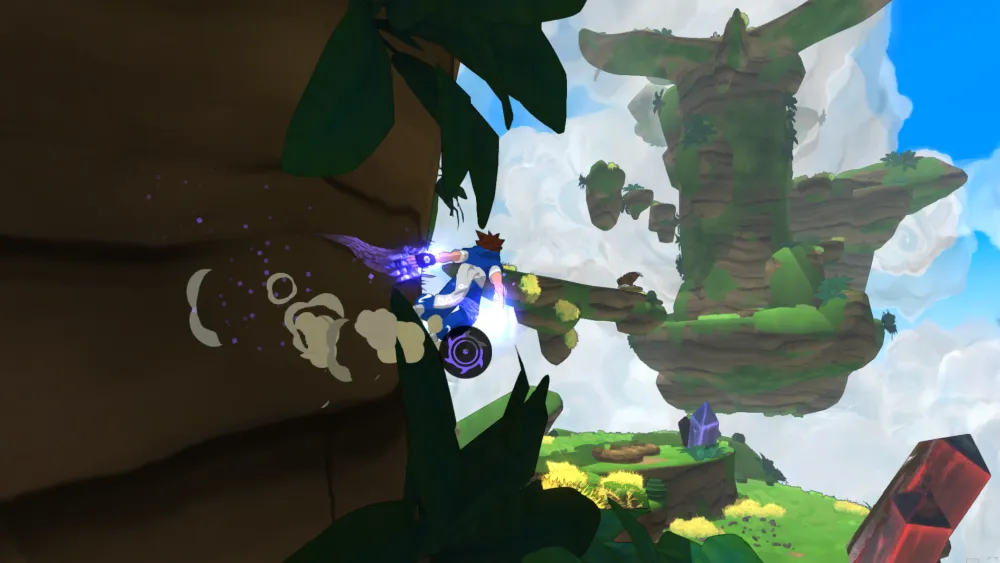
Zefyr is a love letter to 3D action games of the early 2000s, specifically the likes of Wind Waker and Beyond Good & Evil. Zefyr is also a solo-developed passion project that's taken 12 years to complete, finally coming out in 2025. Because of that background you can give it a polite excuse for some of its jank; ut I would say it's a lot more appropriate to applaud it for the effort. That a single person has built and released from scratch such a tight and engaging full-3D open world action game is genuinely incredible, and a real showcase of indie gaming passion and craft.
In Zefyr you play a plucky young adventurer who lives in an archipelago and is in the middle of doing his "thief" training (basically just a codeword for a questing adventurer, as the game even handwaves at one point) when his sister gets kidnapped and he has to go on a sailing adventure across the islands to track her down. Sounds very familiar, and if there is a downside to Zefyr it is in the writing and character department: the narrative starts out as a Wind Waker nod and then remains so casual and care-free it borderlines on bothersomely throwaway, the characters have come from a How to Draw Manga book and the writing feels like it hasn't quite retained its nuances when going through the language barrier into English. There is, basically, little to draw the player in from this perspective. The reason I state all these negatives immediately is because they are the first impressions you face when you start the game and I could see someone shrugging it off based on them. But stay with it past the tutorial sections, and Zefyr opens up to a little surprise gem of a game.
Zefyr's gameplay is straightforward for anyone who's played its inspirations: traverse the open sea, explore the islands, run through dungeons, collect the collectibles, face a couple of simple bosses. The formula may be tried and tested but the execution is so dang tight that it proves why that formula is so beloved, and Zefyr is a genuinely magnetic game to play. The dungeon areas all have a unique layout so that none of them feel like you're repeating previous experiences, the side quest to find all the ill animals to cure is at its best light puzzling for the player to resolve (this bit really reminds me of the photography side quest in BG&E, and some of my favourite moments of the game were reaching particular animals either for the spectacle or the feel-good vibe of it all), and though the combat is incredibly one-dimensional the game tries to encourage the player to Batman their way through and pick off individual guards in stealth, which is a whole lot more fun (and once you get the bow, the overpowered sniping of individual enemies is almost if not even more fun). Above all, the simple act of movement is a joy. Zefyr has really nailed down how good the platforming should feel, from climbing to leaps of faith, and its many vertical obstacles to climb become engaging combinations of puzzling and platforming, which also reward players for testing their skills by trying to bypass sections with a little cunning. The game's final unlockable skill is the grappling hook, which is not a cowardly Zelda hookshot that can only grapple specified points but which can attach to anything, and the sheer rush of ultimate power it provides is such a rewarding end-game treat.
Yes, there are aspects that Zefyr could do better to be considered truly fantastic but in all honesty I had a hard time letting this game off my grip once it opened up and revealed its hand: the adventuring simply feels good and kept me hooked. From a purely mechanical perspective it's not only really engaging and addictive to play, but especially in this time and age when this kind of action adventure has gone into hiding, it serves as a reminder of what we're missing out on. At the price point it's an easy game to recommend, and it's inspiring to see a solo dev create an experience like this. The dev is also actively listening to the players and as of early 2026 the game is still seeing small balance fixes and bug tweaks based on user feedback, to form an even more rock solid play experience.
Recommended?: Worth picking up in a sale if you have a particular nostalgia for early 2000s 3rd person action adventures, just don't expect to play it for the story.
Phantom Fury
The prevalence of high-octane, high-adrenaline run'n'gun "boomer shooters" in the retro-styled FPS market has rewritten history to present a view that all the shooters back in the 1990s were simple slaughterfests. Which is very much not the case, and in the mid-90s and particularly following the mega success of Duke Nukem 3D a secondary pillar of FPS gaming emerged and ultimately began to dominate the genre. These games were still action-packed quickdraw shoot-a-thons but they scaled down the brutal enemy hordes and mindless splatterfests in favour of more complex level designs, more nuanced pacing where everything felt connected and more intricate weapon designs which favoured picking the right tool for the right kind of situation, or allowed players to find different means of fun through their particular armoury choices. This sort of FPS design ultimately evolved into the likes of Half-Life, which then inspired another wave of shooters which retained the old design elements but tried to also dip their toes in Half-Life's sheer intricacy. This led to the birth of, in lieu of a better term, the 'mid-tier FPS'. The likes of Sin, Blood 2, Soldier of Fortune etc which weren't necessarily particularly inspired and definitely had more than their fair share of jankiness, but which had a curious charm in their slightly confused, lightly ambitious and thoroughly entertaining manner. These were not games that anyone would necessarily ever praise as one of the greats even at the time, but they stuck with those who played them and still offered something of a unique vision that made them worthwhile to replay over and over again while us young gamers saved our pocket money to the next game we could get in the era before Steam sales.
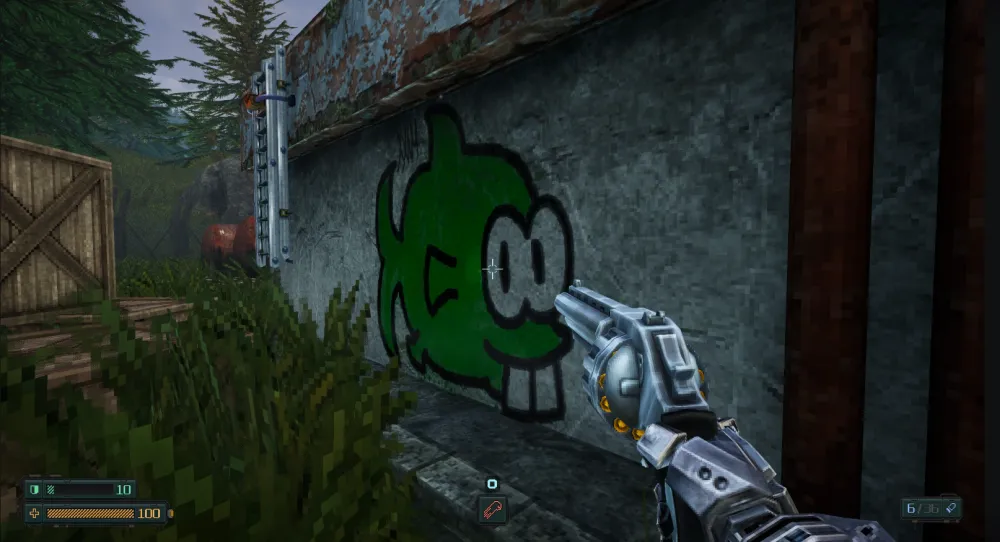
2019's Ion Fury was a loving tribute to Duke Nukem 3D and the other Build Engine games that followed it, and 2024's sequel Phantom Fury is a nod towards this very specific wave of early 2000s shooters. From the gimmick-y weapons to the long levels which dip their hands in unexpected tonal and design changes from one to the next, to the very specific brand of linearity that mixes the mindless shooting of yore with the HL-esque sense of a "journey", and even to the graphics - Phantom Fury is a love letter to that ca. 1999-2000 brand of action shooting and for that alone I have to give it some kudos. You can tell it has been made by people who understand FPS gaming history beyond just the obvious reference points, and as someone who was playing oh so many FPS games back in that period it does warm my heart to see this period represented. It's why I picked up Phantom Fury despite the mixed reviews all over the place - and it's why I do remain a little more positive about it, even if those mixed reviews are right.
Strictly speaking, there's nothing inherently wrong with Phantom Fury. I like what it goes for, its design aesthetics are rock solid and it knows when to switch pace and offer something completely different to the previous level. Some have reported technical issues but I was spared of these, apart from two specific keybinds resetting every single time I booted the game - I'm not saying they don't exist but they didn't occur for me. The plot is absolutely whatever but it doesn't get in the way of some entertaining shootybangs and the gunplay is robust and entertaining. The levels are designed well and full of little details that make them feel like actual spaces people genuinely inhabit, which makes them entertaining to wade around.
The big But of Phantom Fury is that a lot of it feels like it's been left halfway. It offers interesting setpieces and fun twists when it wants (jumping around a moving train, spending a level watching a mutant strike occur from the initial moment of civilian piece to full-blown warzones, the genuinely surprising cameo at the end), and then forces you to wade through identikit warehouse and sewer corridors the next; similarly while there's a lot of variety, like Ion Fury the game runs just a couple of hours too long to really hold up. It offers you a skill and weapon modification system, but a third of the veritable artillery you carry either only has a single upgrade option (unlocking the alt fire) or none at all. The sound design is overall really good but most of the game lacks music and the results are less atmospheric and more like an audio bug. The oft-expansive levels look like they provide plenty of exploration options but there's more dead ends than secret stashes. The vehicle sections are a faithful nod to this period of gaming, but no one liked them back then and no one likes them now. And so on. For every positive thing about Phantom Fury there's always something negative to balance it out, and so my enjoyment of the game became a series of moments of exhaustion vs eagerness to see what's round the corner.
This makes it tricky to recommend, especially in an environment like Steam (where I'm cross-posting this) which offers a binary likey/no-likey option and that's such an awkward fit for a game like this. Because I do kind of recommend Phantom Fury, particularly if you were playing FPS games around the turn of the millennium - it taps into that mid-tier FPS feel very accurately and reminded me why I did enjoy replaying these kinds of games over and over again. But do the good outweigh the bad for someone who doesn't have that touch point, or someone who simply wants a rock solid FPS experience? Probably not, and I can feel that as well: there are some very easy tweaks that could be made to Phantom Fury to really elevate it and the potential is so close to reach that it's frustrating it doesn't. A mixed bag then, but one that still offers something different in the crowded retro-FPS scene and a game that taps into aspects of those old FPS games that I really wish other devs would be inspired by at this point, hopefully with more polish.
Recommended? At your own risk really - there is something worth playing here if you're a fan of the period/genre, but you might find it a bit too unbalanced in its flaws.
Mouse: P.I. for Hire
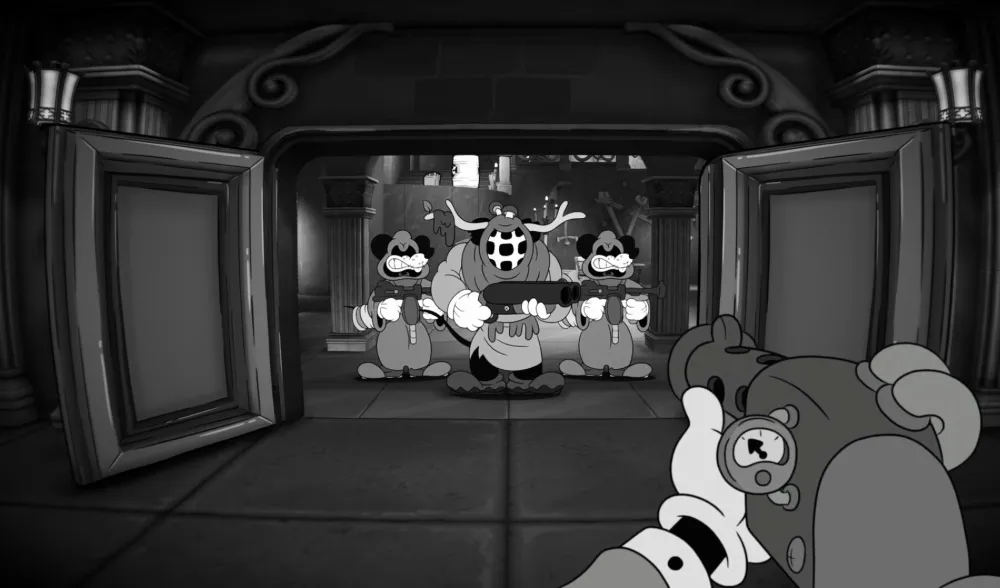
First things first, the Gimmick: Mouse P.I. looks great. The inkblot/rubberhose style has been lovingly brought to life in an environment that ultimately defies its very dimensions, and it's clear the developers have a genuine passion for the aesthetic and the era right down to how everything (and everyone) wobbles. It's not 100% true-to-form in the manner of, let's say, Cuphead, but that's the result of bringing this defiantly 2D aesthetic into 3D and not everything translates perfectly. However, the devs utilise a lot of tricks to make it come true as much as possible, and the results are just delightful - plus with the plentiful audio and video filter options, you can customise just how sharp or vintage your experience is to add that extra crunch and atmosphere if you wish to. The character design is also fantastic, with so many excellent-looking NPCs and enemies, everyone a character that someone in the art department poured a lot of love and detail into. Some of the elements even cross reference points: all the enemies are 2D sprites and the way the corpses of your fallen foes always rotate to face you really reminds me of old Build Engine games from the 1990s, and that's a fun and unexpected touch in its own right. The best thing about Mouse P.I.'s aesthetics though is that it never gets old: it retains its charm even once the novelty wears off and living in a black-and-white 2D inkblot world becomes Normal, and that's how you can tell just how well-thought out all the elements the design is. The game's audiovisual strengths shine through across the entire experience, and never once you'd want them to stray away from their dogma.
But there is a game behind the gimmick too and whilst the visuals are a throwback to the roaring 1930s, the game turns out to look towards mid-90s FPS games beyond just the aforementioned Build Engine nods. And, very specifically, not to the current interpretation of the era as a horde-shooter slaughterthon that the modern Doom games and all the 'boomer shooters' have made it out to be, but to the post-Duke 3D period of more thought-out shooterfests where the action was boosted by the attention given to level design, world building and other design elements. Mouse P.I. presents a good balance of exploratory navigation of the linear areas and the more intense shooting action, typically in the form of small waves in makeshift arenas. Movement and the right utilisation of Jack's vast arsenal is key, especially on the higher difficulties; I played on the highest Supersleuth difficulty, which isn't typically my MO but was recommended by a few FPS veterans and I thought it struck a good balance between the power fantasy and making sure you pay attention to what's going on in order to survive. There's a very "classic" vibe to the shooting and the action isn't overloaded with complexities - no combos or finishers, no mega-speed run 'n' gun, no tactical tricks - but I think that's a good thing. It shows that the basic elements can be just as enjoyable when executed well, and this is absolutely a case where a few simple tricks keep things tight and enjoyable throughout the entire game.
Plus, with the abundance of secrets, various collectibles each which have their own purpose (and only one type of which is entirely missable, others can be acquired later in exchange for cold hard cash), a surprisingly decent if a little simple card-playing mini game, side quests and a level-up system for the weapons, there's still quite a bit extra in Mouse P.I. to bring a little extra flavour to the core gameplay. Again, nothing particularly mind-blowing or indepth, but just enough to provide an extra bit of stimulus. The game is surprisingly long, too - it took me close to 20 hours to complete, as the game kept both expanding and tightening its plot strands As the hard-boiled detective Jack Pepper the player is tasked to crack open a few seemingly unrelated cases (a lost friend, a dead actress, an influx of sudden disappearances) which ultimately all tangle into one big conspiracy plot. What this means from a gameplay perspective is that Jack's ever-expanding adventures have given the devs the excuse to expand the artistic reference points beyond just the initial film noir touchpoints, and the various locales that Jack goes through act as a series of loving nods to all kinds of 20s/30s inkblot animation tropes, taking Jack from film studios and their self-referential animation nods to spooky graveyards, insane asylums and underwater, among others. There's rarely a repeat moment and this too helps keep the player's attention focused, making that surprisingly extended length a real positive. Overall, there's proper meat to Mouse P.I.'s bones and you want to keep coming back in just for the gameplay alone.
It's not a flawless game but none of its issues are so glaring that it'd put a serious dent to the fun. There's a few unexpected difficulty spikes and particularly the bosses can become a hassle for not entirely fair reasons, but the caveat here is again that I played on Supersleuth so some of the unavoidable extra damage my Jack endured probably doesn't apply all across the board. The main complaint I've got is the weapon balance. The game boasts a huge array of guns (positive!) but roughly half of them feel like they were designed as fun ideas first and foremost, and it wasn't quite tested out whether they'd actually work functionally in combat: weapons such as the fire-spewing double-barrel shotgun or the enemy-stunning mind-beam are visually a ton of fun and they're great conceptually, but never quite fit into the rhythm of the combat either because of relatively low damage, slow speed or the gimmick not actually as practical as it reads on paper. The worst offender is the special weapon you unlock through the tokens earned from the card games, which on paper reads like the game's BFG (complete with extremely limited ammo) but feels like a complete pea shooter. So, you end up relying a little too much on some of the guns that do strike that perfect functionality, especially the turpentine gun which is both a great toon-befitting idea and which is not just accurate but also stunlocks and applies a DoT that kills 90% of the enemies in the game with one shot. Again, nothing that ruins the game per se, but it is a little disappointing how using some of the more "fun" seeming games felt like you're intentionally setting yourself up for failure. I'm also not keen on the game's insistence on savepoints over a good ol' quick save; never once did I really feel like my inability to save really contributed to the game's mood and whilst the checkpoints are frequent, there were a couple of times where I felt like a quickload in a specific spot would've been better to repeating a wider section following a long death sequence.
Also a sidenote for us non-WASD users - the game shipped without the ability to change movement keys from WASD (guys, come on, it's 2026, we had this handled in the mid-1990s) and though this was fixed really quickly - shout-out to the devs for being on ball with this - there are still a few quirks remaining from the perceived default keybinds. You can't change the keys for e.g. your flashlight or for entering buildings on the world map - neither are critical in the slightest so it's easy to live with them, but it is a bit of an unnecessary oversight.
Overall, Mouse P.I. is a rock solid FPS that pays fantastic tribute visually to one era, and an excellent tribute in its gameplay to another era. There's a lot more to its charm than just its obvious USP: from day one this definitely had the feeling of potentially being a game that could never outlive its premise and its proof of concept trailer, but the devs have made it sure that it succeeds as a gameplay experience as well. If you're a retro shooter fan, this is well worth picking up - and the unique visuals are the cherry on top.
Recommended?: Absolutely if you're into old-school FPS games.
Want to comment or get in touch? You can send any thoughts through this link!